
Oklahoma District Court Probate
District Court exercises Oklahoma probate jurisdiction. Its probate docket covers admitting a will, appointing a personal representative, determining heirs, identifying and valuing estate assets, giving creditor notice, resolving claims, authorizing sales when needed, reviewing accounts, distributing property, and discharging the representative. Related District Court files include guardianships, trust disputes, and proceedings to determine death or heirship. A will does not transfer court-supervised property until the court admits it.
Venue usually begins with domicile, not the place of death. The Oklahoma probate venue statute, 58 O.S. §5, directs a resident decedent's proceeding to the proper county District Court and supplies rules for nonresidents and Oklahoma property.
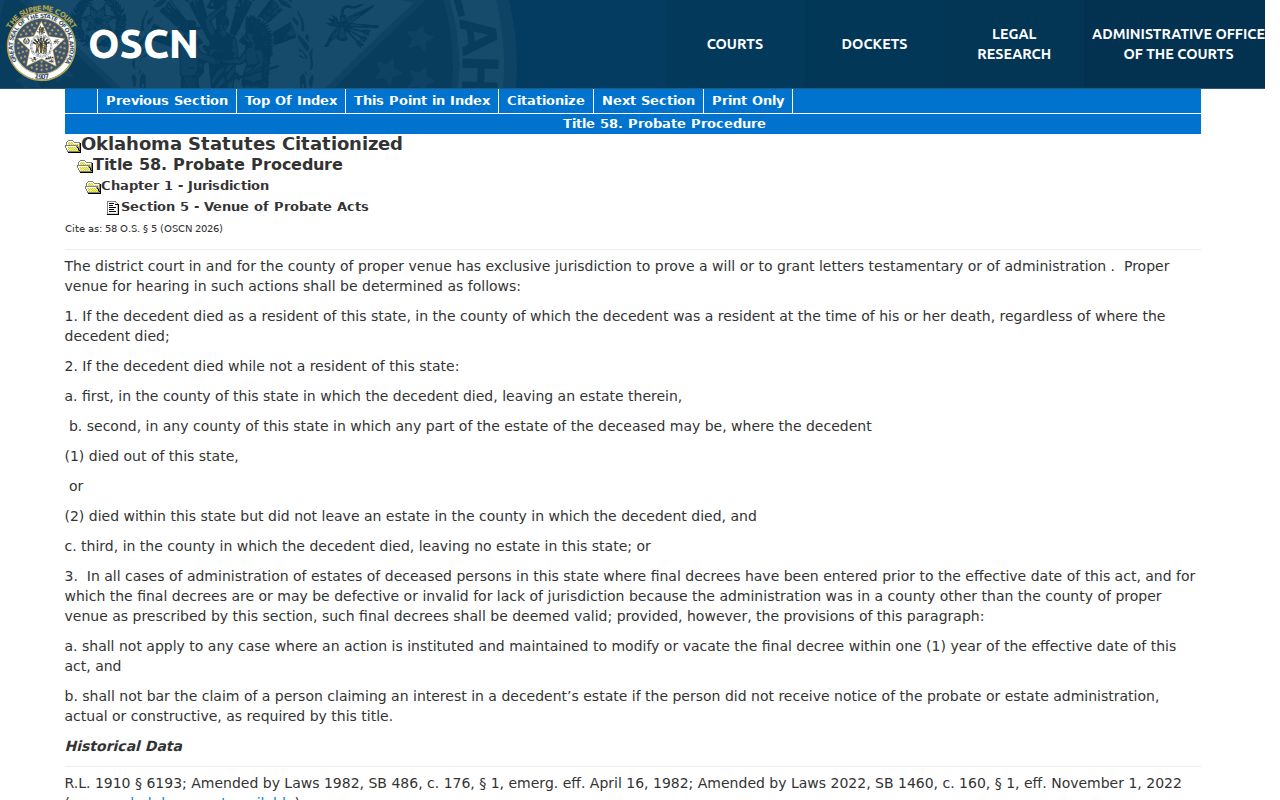
The venue rule explains why a hospital or death location may differ from the county that holds the estate file.
Oklahoma Probate Terms Defined
These terms identify the people, authority, and filings seen in an Oklahoma estate or guardianship record:
- Testator
- The person who made a will.
- Executor or personal representative
- The person appointed by District Court to administer the estate. A will may nominate an executor, but court-issued authority controls.
- Intestate
- Dying without a valid will that controls the probate property, so Oklahoma succession law determines heirs.
- Letters testamentary or administration
- Certified court authority allowing the appointed representative to act for the estate.
- Guardianship
- A proceeding protecting a living minor or incapacitated adult through powers defined by the court order.
- Conservatorship
- A property-management concept whose scope must follow Oklahoma law and the signed order rather than another state's labels.
- Inventory
- A filed account of estate property and values within the proceeding.
Letters can change or expire, and a public appointment order may coexist with confidential medical evaluations. Ask for the current certified instrument when authority matters.
Search Oklahoma Probate Records
Use the OSCN docket search, choose the likely county, and select or enter the PB case type. Search the decedent's legal name, then the personal representative and known heirs when needed. Limit the year range at first. Case numbers repeat across counties, so retain both the selected database and complete number. OSCN depth varies, and older packets may exist only on paper or microfilm.
- Identify the decedent's domicile and any county where Oklahoma real property was held.
- Search OSCN by county, name, date range, and
PBcase type. - Open likely results and verify the caption, filing date, representative, and judge.
- Record the full number and identify the exact will, letters, inventory, order, or decree needed.
- Ask the county Court Clerk for inspection, a mailed copy, or a certified copy and archive retrieval.
A missing result can mean wrong venue, spelling variance, no filed probate, a legacy record, or assets that passed outside probate. It does not prove that the person left no will or property.
Oklahoma Probate and Bankruptcy
Oklahoma probate remains a state District Court matter. A separate federal bankruptcy case can affect estate claims, collection, or property through federal law, but it does not become an Oklahoma probate file. Oklahoma has federal bankruptcy courts associated with its Northern, Eastern, and Western judicial districts. Search federal matters through PACER and state probate through OSCN and the Court Clerk.
The Northern District of Oklahoma Bankruptcy Court is one official federal source.
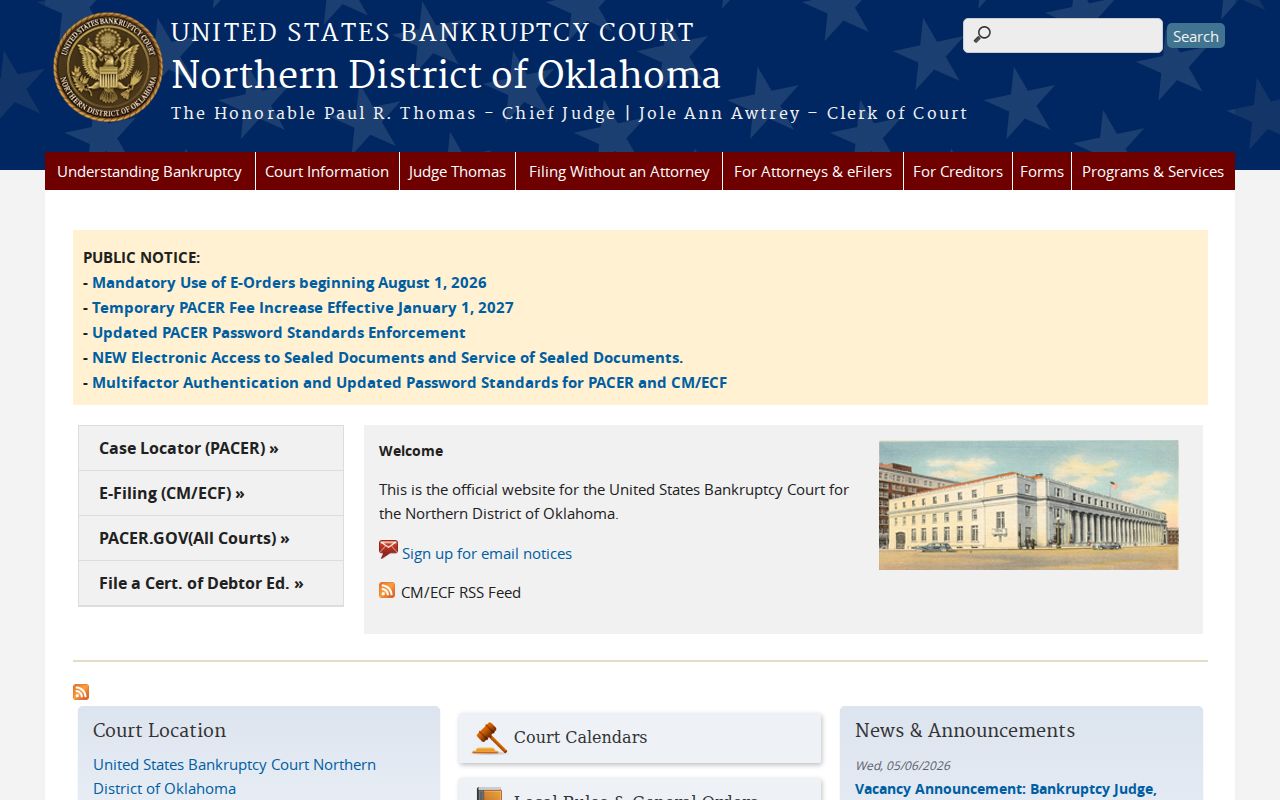
Its docket is separate from every county District Court probate docket.
The Eastern District of Oklahoma Bankruptcy Court provides the federal route for matters filed there.
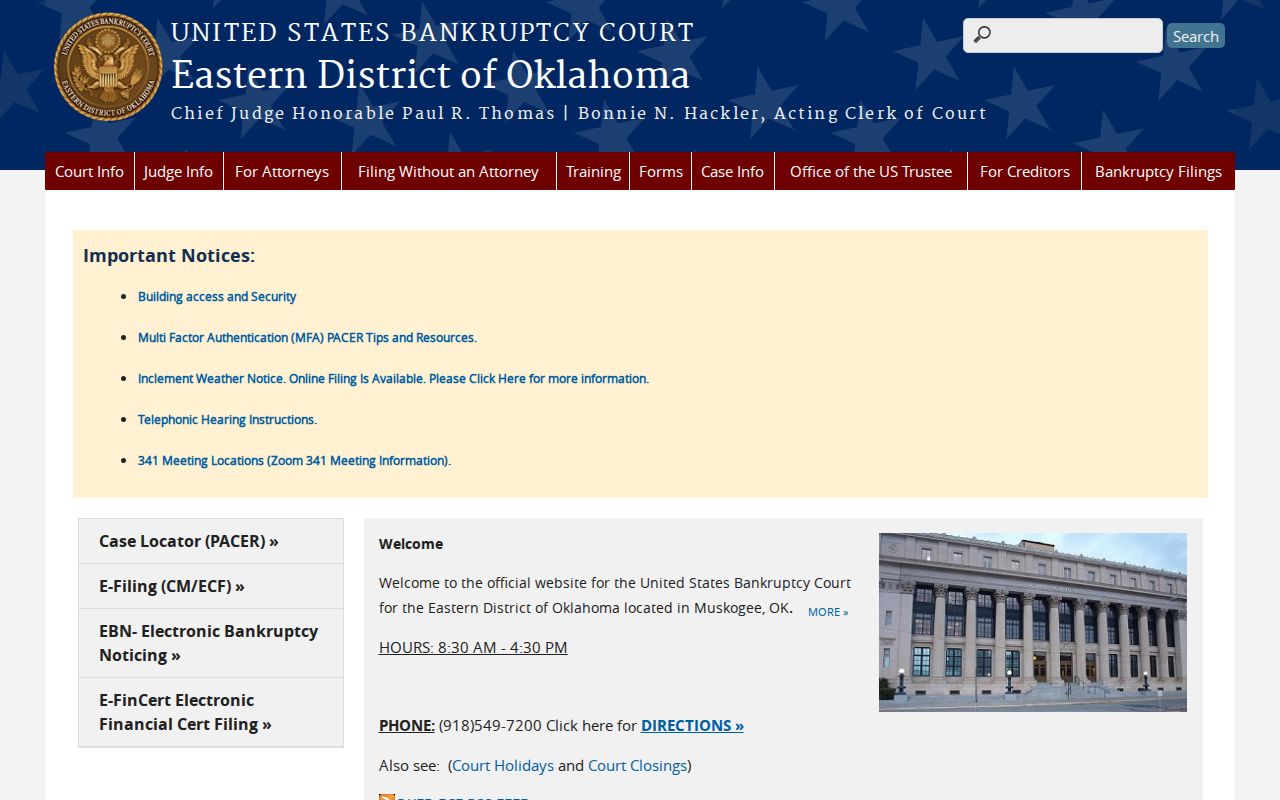
A federal bankruptcy petition or claim does not replace the will, letters, or distribution decree held by an Oklahoma Court Clerk.
Find the state file: Browse all 77 Oklahoma counties in the county directory, then contact the District Court's Court Clerk for the probate case.
Oklahoma Probate Filing Fees
No single statewide dollar safely describes every Oklahoma estate. Filing assessments combine with service, publication, bonds, appraisals, certified copies, archive retrieval, postage, and professional costs. Ask the proper Court Clerk and newspaper for current itemized quotes. A pauper or forma-pauperis affidavit may request relief from qualifying court costs, but a judge decides it and outside expenses may remain.
| Item | Amount |
|---|---|
| Probate petition or guardianship filing | County quote required |
| Service and publication | Provider and case dependent |
| Bond, appraisal, or professional work | Estate dependent |
| Plain or certified copies | County quote required |
| Archive retrieval and postage | Request dependent |
| OSCN docket search | Free |
Note: Fee and statutory research was verified August 11, 2026; confirm live amounts and the current law before filing.
What Oklahoma Probate Records Show
A typical public file begins with the estate caption, case number, filing date, petitioner, personal representative, lawyers, assigned judge, petition, and will notation. Later entries can include a hearing order, mailed or published notice, proof of service, letters testamentary or administration, inventory and appraisal, creditor claims, motions, sale requests, accountings, a decree of distribution, and discharge. Each item answers a different question. A petition requests relief, while a signed order proves what the judge granted.
Ordinary administration moves through a set of court-controlled stages. The petitioner determines venue, locates the original will, and files the petition with death evidence and proposed notices. After the hearing and required service or publication, the judge may appoint a representative and issue letters. The representative then identifies assets, notifies creditors, addresses claims and taxes, seeks sale authority when required, and accounts for the estate. Distribution follows a signed decree, and discharge closes the representative's authority. A contest, missing heir, tax issue, creditor dispute, or complex real estate can extend the proceeding. Later-discovered property may also require reopening. For that reason, an early appointment entry or an online closed label should never be treated as the final distribution. Read through the latest decree and discharge, then ask the Court Clerk whether later filings exist.
Letters show the representative's authority during administration. The inventory reports estate assets and values under filing rules, but it is not the net amount distributed because debts, exempt property, liens, taxes, and expenses intervene. The final decree may determine heirs and distribute real property. A later deed or recorded decree can also appear in County Clerk land records, which are separate from the Court Clerk's judicial file.
Oklahoma also provides a summary-administration procedure under 58 O.S. §245. Summary does not mean a private counter transaction. It remains a court case with a petition, notice, possible objections, and a decree. The official provision carried an August 2026 supersession warning, so its current eligibility conditions must be checked before anyone relies on a dollar threshold.
The official summary-administration statute lists required petition information.
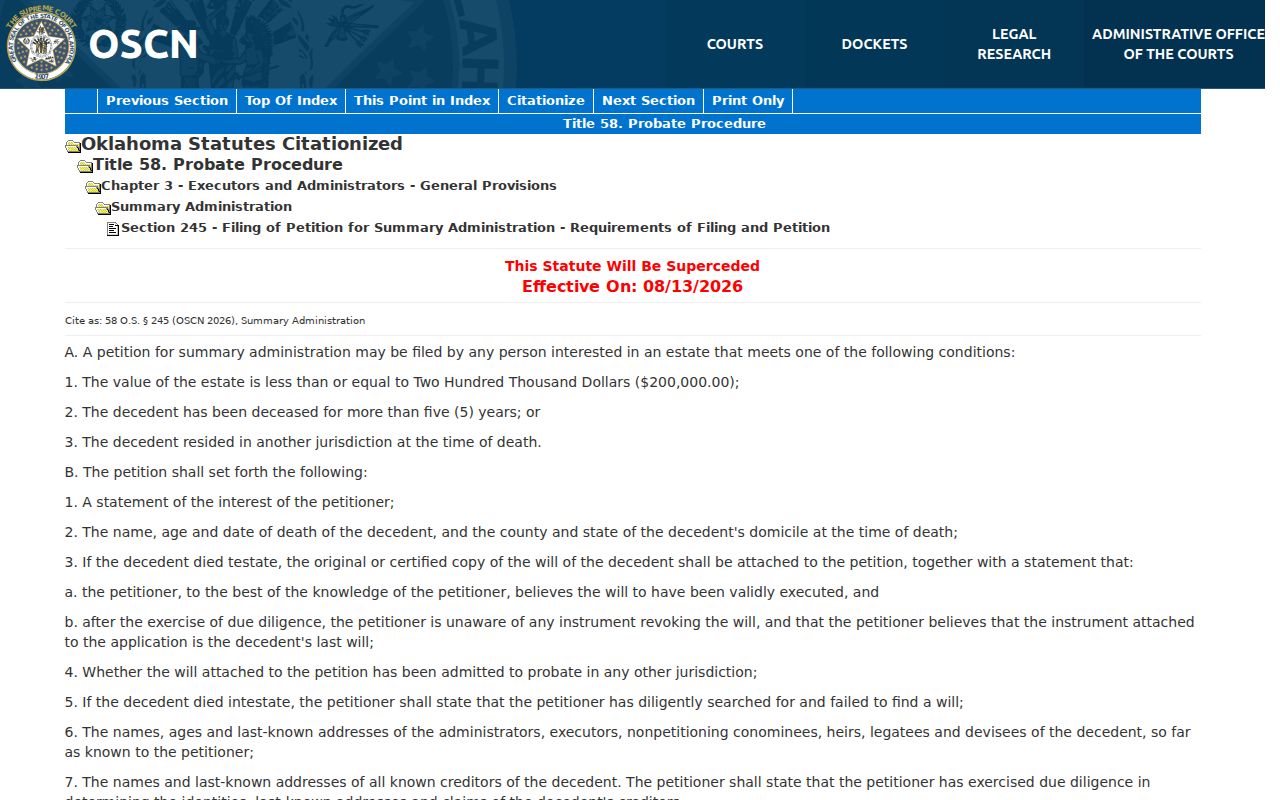
The petition fields help a researcher recognize the decedent, domicile, estate property, heirs, will, and requested representative in the docket.
Restricted Oklahoma Probate Records
Public access does not expose every detail. Social Security numbers, bank and account numbers, medical records, protected addresses, and minor identifiers should be redacted. Guardianship evaluations and evidence about capacity can be confidential even when an appointment order or public docket entry remains visible. Adoption and mental-health material follow separate restrictions. A sealed item requires the access allowed by statute, rule, or court order.
Ask the Court Clerk whether a missing document is unavailable because it is confidential, sealed, archived, checked out, transferred, or never filed. Request segregable public portions where possible. Do not infer estate value or a person's capacity from a docket label alone. For current representative authority, request certified letters and any later modifying or terminating order.
Guardianship concerns a living person and can include ongoing reports and accountings. It is not part of a decedent's estate merely because both use probate-related dockets. Multiple Oklahoma cases can exist, including a guardianship during life and a probate after death.
Find Oklahoma Probate Records
Use the directory of all 77 Oklahoma counties to reach the county tied to domicile or Oklahoma property. Contact that county's Court Clerk, not the separate County Clerk, and give the complete PB number, decedent's name, approximate year, and exact item. Ask for a plain or certified copy and set a cost ceiling for archive, page, certification, and postage charges.
When no case appears, search former names and related parties, expand the date span, and check whether assets passed by trust, beneficiary designation, joint ownership, affidavit procedure, or without any filed probate. Historical probate may survive in bound dockets, microfilm, or transferred archives even when OSCN has no result. A focused request gives the Court Clerk the best chance to locate it.
Probate may connect with land records, tax records, creditor notices, appellate dockets, and federal bankruptcy, but those sources do not replace the District Court file. The authoritative Oklahoma will, letters, order, and final decree remain with the proper Court Clerk.