
Oklahoma Arrest Records and Charges
An Oklahoma arrest record is created by the arresting police agency, sheriff, or jail. It can identify the person, booking event, arresting agency, initial reasons for custody, listed bonds, and release status. Those entries describe the intake event. They do not show that the District Attorney accepted a prosecution, and they do not prove guilt. A current jail roster can also drop a released person even while a court case remains pending.
A court charge record starts later. The county District Attorney screens the submission and may accept, decline, or change the proposed counts. Once filed, the charging document and amendments belong to the District Court file held by the Court Clerk. The Oklahoma inmate record supplies current booking or custody detail, while the full criminal court record follows pleas, hearings, disposition, and sentence. These records should be matched, not merged.
Note: A booking label is an intake allegation, so quote the filed Information when stating what Oklahoma prosecutors actually charged.
Find Oklahoma Arrest Records and Charges
Begin with the event and jurisdiction. A recent arrest belongs first to the arresting county's official sheriff or jail roster. A city agency may hold its incident and booking record. For court charges after arrest, search the OSCN Docket Search for a county District Court CF or CM case. City-ordinance matters may remain in a municipal court system outside comprehensive OSCN coverage. Tribal and federal prosecutions also use separate sovereign courts.
- Identify the arresting agency, county, city, and approximate date.
- Check the official current jail roster for booking number, listed allegations, bond, and custody status.
- Select the filing county in OSCN and search by case number or defendant name.
- Open the case, read every current count, and note any amended Information or dismissal.
- Request the charging document and final order from the Court Clerk. Use the county directory for the local route.
If no case appears soon after booking, contact the District Attorney for filing status and continue to monitor the county court. A filing can lag arrest. For releasable police or jail material, send a narrow Oklahoma Open Records Act request to the agency that possesses it. Ask for existing public booking, charge, bond, or release records and segregable redacted portions. Active investigation, victim, juvenile, medical, and security information may be withheld.
Oklahoma Charging Documents Compared
The charging instrument tells what was formally alleged, not merely what an officer wrote at intake. An Oklahoma Information is a prosecutor-signed formal accusation widely used after the required preliminary process. A complaint initiates or supports an accusation. An indictment comes from a grand jury. Each may allege probable criminal liability, but none alone establishes guilt. The operative amended filing should be read with the final Judgment and Sentence.
| Document | Source | What It Establishes |
|---|---|---|
| Complaint | Officer or prosecutor under the applicable procedure | Begins or supports an accusation and probable-cause process. |
| Information | District Attorney | States the formal Oklahoma counts prosecuted in District Court. |
| Indictment | Grand jury | Returns formal counts based on the grand jury process. |
Names, statutes, count numbers, offense dates, felony or misdemeanor labels, and modifiers can change from the arrest sheet. Oklahoma does not use one universal class grid for all crimes. Confirm punishment against the version of the offense statute in force and the signed judgment.
Read Oklahoma Court Charge Status
“Arrested” or “booked” means custody and processing, not prosecution. “Submitted” means the agency sent material to a prosecutor. “Declined” means no charge was filed from that submission at that time. “Filed” marks an active court accusation. An amended count has changed, while a dismissed or nolle prosequi count was stopped without necessarily proving innocence. Acquittal records a not-guilty result after adjudication. Conviction follows a qualifying plea or verdict.
Oklahoma's deferred sentence is especially easy to misstate. Judgment is postponed while court conditions are completed, so the docket and order must be read before calling it a conventional conviction. A suspended sentence is different because a sentence is imposed, but some or all incarceration is suspended. Count-level results matter: one charge may be dismissed while another produces judgment.
Note: A roster allegation, OSCN status, and OSBI report can update at different times; verify the latest filed order before stating an outcome.
Oklahoma Charges Versus Convictions
Charges and convictions answer different questions. A charge identifies what a prosecutor alleges. A conviction records the court's judgment of guilt. Public records can preserve an arrest and filed charge even when prosecution ends in dismissal or acquittal, unless access later changes under Oklahoma law. Neutral wording protects accuracy: “the roster lists,” “the Information alleges,” and “the Judgment and Sentence records” each attribute the claim to the right source.
| Point | Charge | Conviction |
|---|---|---|
| Legal stage | Accusation after prosecutor or grand jury action. | Judgment after an accepted plea or guilty verdict. |
| Best document | Current Information, complaint, indictment, and amendments. | Judgment and Sentence plus any later modifying order. |
| Possible next change | Amendment, dismissal, acquittal, or deferred result. | Appeal, correction, revocation, or expungement relief. |
| Repository limit | OSBI displays reported data, not the filed instrument. | A missing report should be checked against the Court Clerk's certified disposition. |
OSBI Oklahoma Arrest History Search
OSBI CHIRP compiles reported Oklahoma fingerprint-supported serious misdemeanor and felony arrest and disposition data. Anyone with an email can create an online account. A name search costs $15 and is nonrefundable; sex-offender and violent-offender products cost $2 each when selected. Submitted identifiers can include name, date of birth, race, sex, Social Security number where authorized, and up to three aliases. The result is similarity based, so it must be identity checked and verified at the originating court.
The official OSBI background-check instructions describe online, mail, fax, and in-person channels.
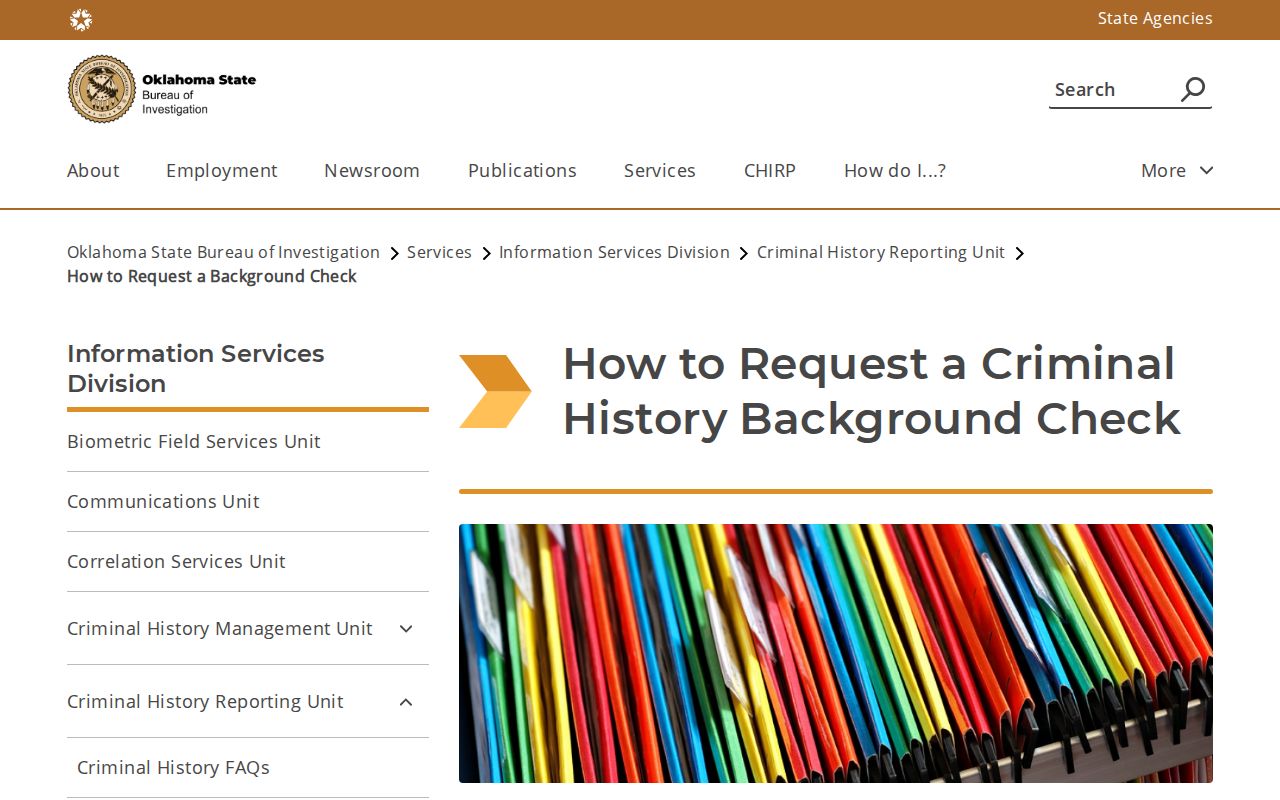
This official source distinguishes the $15 name search from the $19 fingerprint request and explains why original fingerprint cards cannot be faxed.
Paper and fingerprint requests use OSBI's form and authorized payment rules. A criminal-history response may show reported arresting agency, date, charges, court or case, and disposition. It does not contain the county's charging pleading. A missing disposition should be resolved by obtaining a certified Court Clerk record and following OSBI's update procedure.
Note: OSBI search charges are nonrefundable, and a name-based similarity result still requires identity matching and county-court verification.
CHIRP and Oklahoma Court Charges
The Criminal History Information Request Portal is useful when the filing county is unknown or several Oklahoma counties may be involved.
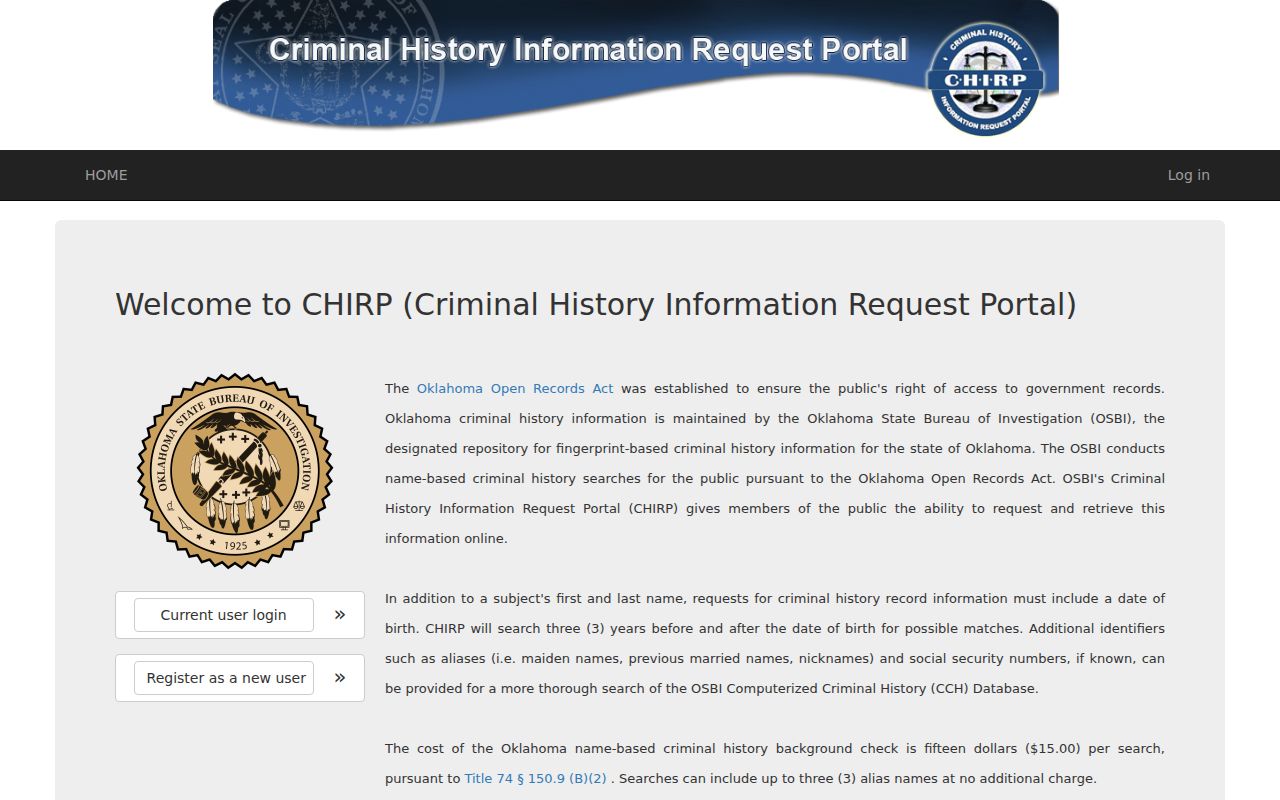
The portal image reflects the account-based access route, but a CHIRP match is not a certified adjudication and does not search other states, driving history, or every municipal event.
Use OSCN and the Court Clerk to read what the prosecutor actually filed. Use the sheriff roster for current booking and bond. Use the investigating agency for releasable police records. A District Attorney may withhold active investigative, victim, discovery, or work-product material even when the stamped Information is public through the court file.
Oklahoma Sealed and Expunged Charges
Oklahoma expungement under 22 O.S. §18 depends on the exact eligibility route. Acquittal, dismissal, no charge after arrest, completion of a deferred sentence, qualifying convictions, sentence completion, pending charges, and waiting periods can matter. The petitioner files in the District Court with jurisdiction, identifies every custodian to be affected, gives notice, and seeks an order under sections 18 and 19.
| Point | Sealed Record | Expungement Order |
|---|---|---|
| Authority | A confidentiality statute, protective order, or other court order. | Qualifying relief under Oklahoma sections 18 and 19. |
| Public effect | Restricts the document or file within the order's scope. | Changes normal public access for named records and custodians. |
| Government access | Authorized access can remain. | Nonpublic law-enforcement or court use may remain where law allows. |
| Follow-through | Read the order before seeking access. | Serve Court Clerk, OSBI, arresting agency, prosecutor, and all named holders. |
A signed order is not the same as instant suppression. Keep certified copies, allow processing, and recheck OSCN and OSBI. Independent news, private copies, federal, tribal, and out-of-state records are not automatically erased by an Oklahoma county order.
Request Oklahoma Arrest Records
The Oklahoma Open Records Act supports prompt, reasonable access to existing public-body records unless another law protects the material. Ask the sheriff or police for a named booking sheet, public charge and bond log, release entry, or releasable incident record. Include the agency division, date range, name, incident or booking number, precise categories, preferred format, and a cost estimate or ceiling. An agency need not answer legal questions or create a new report.
Juvenile files, active-investigation details, victim information, medical data, security content, and records covered by a court order may be restricted. Court filings redact specified identifiers under 12 O.S. §32.1. Request the segregable public balance when a document mixes open and protected facts. A denial should identify the legal basis.
Note: Public access permits lawful inspection, but it does not remove consumer-reporting, privacy, or anti-discrimination duties governing later use.
Federal and Tribal Charge Boundaries
An arrest in Oklahoma does not always lead to an Oklahoma District Court case. Federal prosecutors file in the appropriate U.S. District Court, and tribal prosecutors use their own sovereign courts. OSCN does not replace PACER, and county records do not comprehensively include tribal proceedings. The caption, arresting agency, charging authority, and case number are stronger routing clues than the person's home address.
The official U.S. Attorney for the Eastern District of Oklahoma illustrates one federal charging authority.
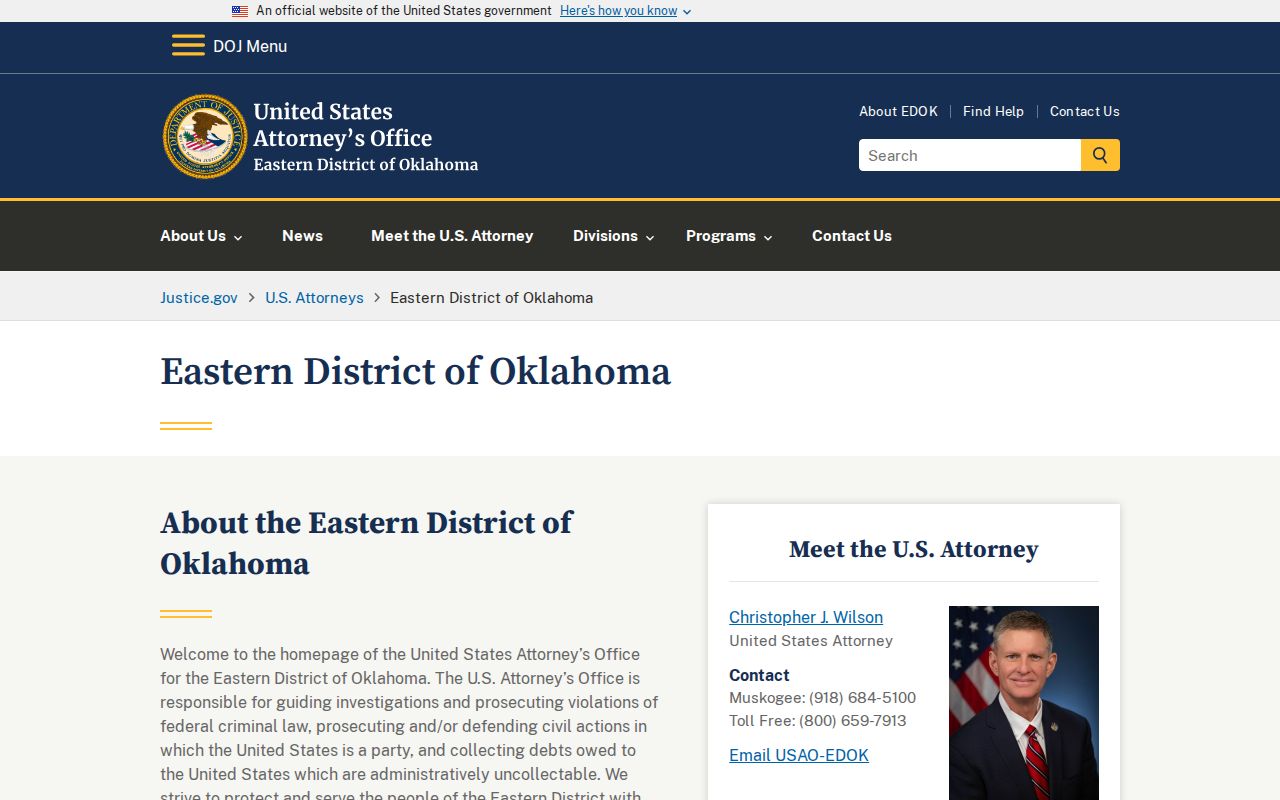
The image reinforces the sovereign boundary: a federal Oklahoma prosecution belongs in federal records, not a county OSCN case merely because the arrest occurred in the state.
Verify Oklahoma Charges by County
Finish with the source office. Record the booking number, county database, full CF or CM number, current count, and latest material order. Ask the Court Clerk for the Information or indictment, any amendment, and the final disposition needed for the task. Confirm financial balances or warrants directly because a copied docket can lag later action.
The Oklahoma county directory reaches the Court Clerk, sheriff or jail, and local alternatives in all 77 counties. If no result appears, test aliases and adjacent dates, then check the city municipal court, tribal court, or federal court named by the event. One source's silence does not cancel a record held elsewhere.