
Oklahoma Criminal Records: Two Systems
An Oklahoma criminal case file is the judicial record of one prosecution. The Court Clerk in the filing county opens it when a complaint, Information, or indictment reaches District Court. Its appearance docket then tracks the defendant, formal counts, counsel, bond orders, hearings, motions, plea, verdict, disposition, sentence, costs, and later appeal or revocation events. The clerk-stamped papers remain the source documents. The arrest and charge record covers the earlier booking-to-filing path, while the criminal case file shows what the court did after filing.
The second system is an Oklahoma State Bureau of Investigation history. OSBI compiles fingerprint-supported Oklahoma arrest and disposition reports received from agencies and courts. It can connect reported events across counties, but it does not provide the Information, plea form, orders, or Judgment and Sentence from one case. Nor is it an FBI check or driver record. A careful review uses the repository to locate reported history and the county file to prove the exact outcome.
Note: Save the county with every case number because the same Oklahoma number pattern can identify different files in different county databases.
Search Oklahoma Criminal Court Records
The Oklahoma State Courts Network Docket Search is the public starting point for CF felony and CM misdemeanor District Court cases. Choose the county database first because identical case-number patterns can exist in more than one county. Name, filing dates, and case type can narrow a query. Municipal ordinance matters may stay in a city system, and tribal or federal cases use their own courts. OSCN depth also varies by county and time period, so an empty result is not a final answer.
- Select the likely county or court database in OSCN.
- Use the full case number when known. Otherwise search the surname, then add a first name and a restrained date range.
- Open each plausible result and verify the caption, county, filing date, counsel, and count details.
- Read the full event text, not just a code or displayed status. Note the latest material order and any later recall, appeal, or correction.
- Ask the Court Clerk for the named document and choose a plain or certified copy. Use the Oklahoma county directory to reach the correct office.
Older paper or microfilm files, documents without public images, and restricted indexes require direct clerk contact. A useful request supplies the county, complete number, caption, approximate filing date, and exact document. Ask for an estimate that covers copies, certification, archive retrieval, and postage. A courthouse terminal may display material that is not remotely imaged.
Oklahoma Criminal Case Stages
A prosecution changes as the District Attorney screens police material and the court rules. The filed Information can differ from the jail's booking label. In a felony, a preliminary hearing tests probable cause unless waived. Bind-over leads to District Court arraignment. Motions may address evidence, discovery, statements, competency, or legal sufficiency. A plea must be accepted by a judge; otherwise a jury or judge decides guilt at trial.
Case flow: Charges Filed › Initial Appearance › Preliminary Process › Arraignment › Pretrial › Plea or Trial › Disposition › Sentencing › Appeal
Judgment and Sentence is the central outcome document. It states the conviction count and imposed punishment, including incarceration, suspended or deferred portions, supervision, fines, costs, restitution, and credit where ordered. A direct Oklahoma criminal appeal goes to the Court of Criminal Appeals. Post-conviction work generally begins in the sentencing District Court.
For the official statutory framework behind public criminal-record relief, the Oklahoma section 18 expungement text is a primary source.
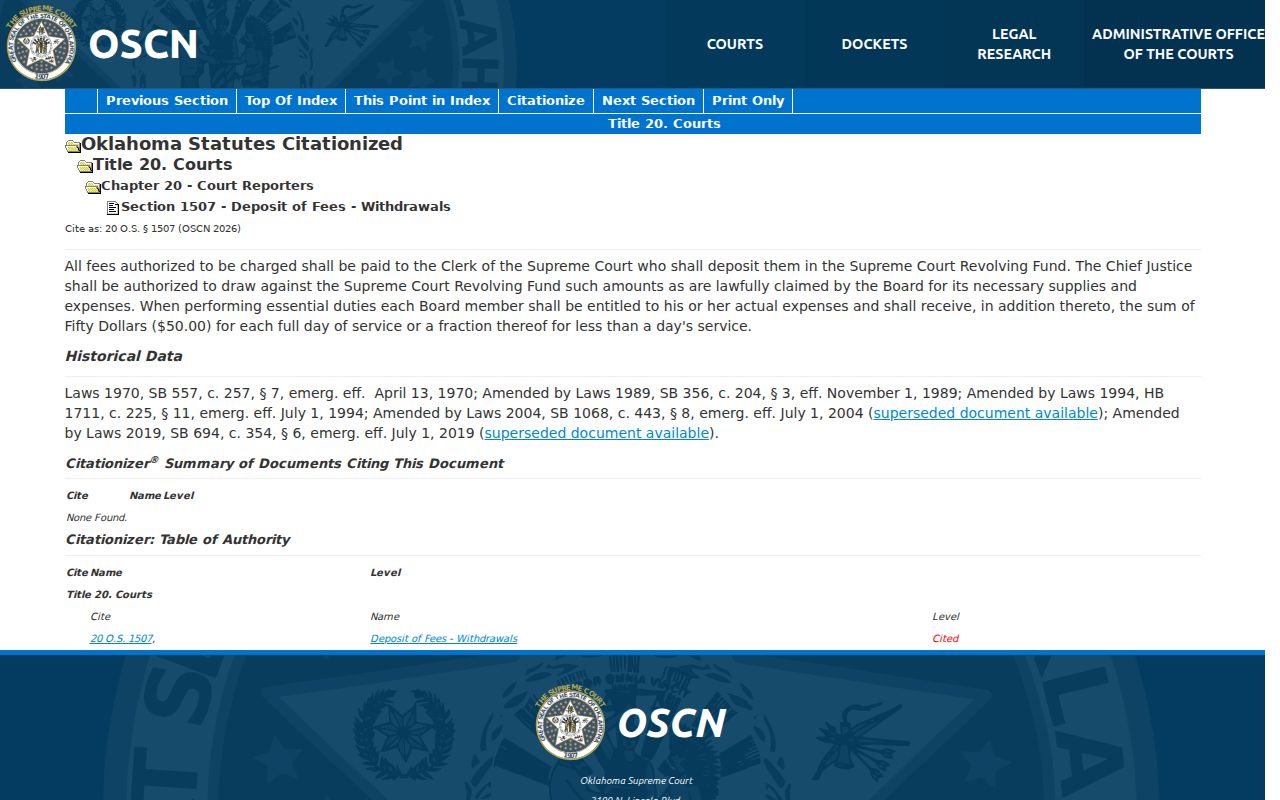
The statute image underscores why eligibility must be checked against the current text and the certified outcome of each Oklahoma case.
What Oklahoma Criminal Records Show
OSCN and the Court Clerk organize an Oklahoma criminal court record around the county database and full case number. The prefix identifies the docket category, not the final result. CF marks a felony case and CM a misdemeanor case. Event rows can include dates, codes, narrative text, responsible party, count, and money. Public images are inconsistent, and a notation that a document is at the Court Clerk's office describes its location rather than granting access to confidential material.
| Field | What It Shows |
|---|---|
| County and case number | Filing venue plus the CF or CM year and sequence that uniquely identify the Oklahoma file. |
| Parties and counsel | State of Oklahoma, defendant, attorneys, judge, and public identifiers subject to redaction. |
| Counts and charges | Alleged offense, statute, offense date, severity, amendments, and count-specific status. |
| Bond and warrants | Release conditions, amount or hold, issue and return events, and later recall when recorded. |
| Plea and disposition | Guilty, no contest, not guilty, dismissal, acquittal, deferred result, or another recorded outcome. |
| Sentence and finance | Imposed term, suspended component, supervision, fines, costs, restitution, receipts, and credits. |
| Post-judgment events | Revocation review, correction, appeal notice, appellate mandate, or later expungement action. |
Oklahoma Charges Versus Convictions
An arrest or filed count is an accusation. It is not a conviction. Prosecutors may decline, amend, or dismiss counts, and a trial may end in acquittal. A conviction exists when the court enters judgment after an accepted guilty or no-contest plea or a guilty verdict. Oklahoma also uses deferred sentences, which postpone judgment while conditions are completed, and suspended sentences, which impose a sentence but suspend some or all incarceration. Those terms should not be treated as synonyms.
| Question | Charge | Conviction |
|---|---|---|
| What is it? | A formal allegation in a complaint, Information, or indictment. | A judgment of guilt based on an accepted plea or verdict. |
| Best proof | Current charging instrument and amendments. | Judgment and Sentence plus any later order. |
| Can it change? | Counts may be added, amended, dismissed, or declined. | Appeal, correction, withdrawal, or expungement may alter access or effect. |
| Repository role | OSBI may show a reported arrest charge. | OSBI may show a disposition reported by the court or agency. |
Read count numbers closely. A dismissal may resolve one count while another remains. Likewise, a case marked closed can still have unpaid costs, probation, appeal, or enforcement activity. The signed order controls over a shorthand portal label.
Note: A certified disposition proves the court result more reliably than a screen capture, repository summary, or third-party background report.
OSBI Oklahoma Criminal History
OSBI CHIRP offers a name-based search of reported serious misdemeanor and felony arrest and disposition history from Oklahoma. Online users create an account, submit subject identifiers, select products, and pay a nonrefundable $15 criminal-history search fee. Optional sex-offender and violent-offender registry products are $2 each. A similarity-based name result does not by itself prove identity. Verify a hit with the originating county's file.
The official CHIRP scope and limitations explain the account requirement, product boundaries, and result caveats.
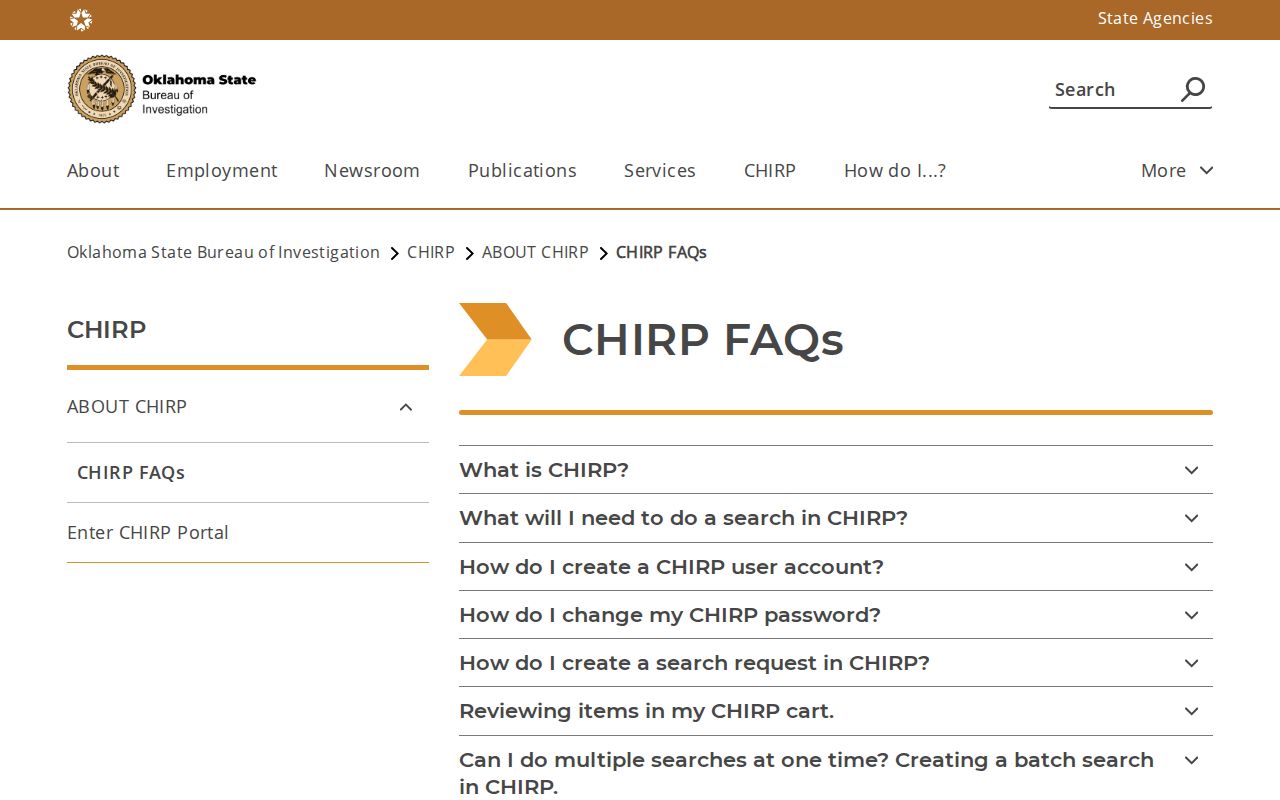
This official source confirms that CHIRP is an Oklahoma repository product, not a replacement for the pleadings and certified disposition in a county criminal case.
A fingerprint-based OSBI request costs $19 and requires original fingerprint cards. Cards cannot be faxed. OSBI permits mail or in-person submission, while qualifying non-fingerprint requests may use the agency's fax and payment process. Paper requesters provide subject and requester details, aliases, purpose, selected products, and return method. Current fees and hours should be verified before submission because they can change.
Note: Fees and submission details above were verified in the Oklahoma research on August 11, 2026; check the official OSBI page before paying.
Read Oklahoma Criminal Dispositions
Outcome words must be read with the actual order. “Dismissed” means the prosecution stopped a count, sometimes without barring a later permitted filing. “Nolle prosequi” records a prosecutor's choice not to continue at that time. “Acquitted” or “not guilty” records no conviction on the tried count. “Deferred” is an Oklahoma structure that postpones judgment under stated conditions. “Convicted” reflects a qualifying judgment after plea or verdict.
Sentence terms also answer separate questions. Incarceration, suspended time, probation, restitution, fines, costs, and credit should be recorded independently. Concurrent terms run together as ordered; consecutive terms follow one another. The court order controls the imposed punishment, while the Department of Corrections calculates custody under law. A projected release date is not a promise. For a missing OSBI disposition, obtain a certified county disposition and use OSBI's correction route.
Oklahoma Sealed and Expunged Records
Oklahoma expungement eligibility depends on the current category in 22 O.S. §18, the exact case result, criminal history, sentence completion, pending matters, offense limits, and any applicable waiting period. A petitioner files in the District Court with jurisdiction, identifies affected custodians, gives notice, and receives a hearing. If relief is granted, certified copies of the signed order should reach the Court Clerk, arresting agency, prosecutor, OSBI, and each other named holder.
| Point | Protective Sealing | Sections 18 and 19 Expungement |
|---|---|---|
| Purpose | Restricts a document or file under a statute or court order. | Changes ordinary public access to qualifying arrest and court records. |
| Scope | Defined by the specific order and legal authority. | Defined by the granted order and custodians named in it. |
| Agency access | May remain for authorized purposes. | May remain where Oklahoma law permits nonpublic use. |
| Next action | Read the governing order before requesting access. | Serve all custodians, allow processing, then recheck OSCN and OSBI. |
The official 22 O.S. §19 procedure and effect adds the operative process.
The statute page shows why an Oklahoma expungement should not be described as universal destruction or instant erasure from every private or federal source.
Access Oklahoma Criminal Case Files
The Oklahoma Open Records Act favors prompt, reasonable access to public-body records, but court files also remain subject to judicial rules, statutes, and orders. Under 12 O.S. §32.1, filed records exclude or redact specified personal identifiers. Social Security numbers, full account numbers, minor information, protected addresses, medical material, presentence records, and sealed exhibits may be withheld while public portions remain available.
Juvenile delinquency and deprived-child records are not ordinary public case files. Adoption and mental-health material also receive strong confidentiality protection. A clerk may state that a document exists without releasing its contents. Ask for segregable, redacted public portions and the legal basis for any denial. The Court Clerk is the practical source for judicial documents, while police reports belong to the investigating agency and prosecutor work product may not be released.
Note: Ask for a named pleading or order instead of demanding “everything,” which improves accuracy, pricing, and the chance of prompt fulfillment.
Verify Oklahoma Criminal Records by County
End a criminal-record search with the custodian. Identify the filing county and full number, save the current docket chronology, and request the Information, relevant order, and Judgment and Sentence needed for the task. If no OSCN result appears, test aliases, adjacent years, a different county, municipal court, tribal court, or federal court. Then ask the Court Clerk about legacy paper, delayed entry, a transferred file, or restricted indexing.
The directory of all 77 Oklahoma counties routes to the local Court Clerk that holds District Court records. Confirm the latest status before relying on a warrant, hearing, disposition, financial balance, or expungement entry. A saved screen reflects one moment; a certified copy proves what the clerk certified on its issue date.