
How to Search Oklahoma Court Records
The Oklahoma State Courts Network Docket Search, commonly called OSCN, is the main public starting point for Oklahoma District Court and appellate docket data. It is free and generally needs no account. Choose the county or appellate database before entering a case number or party name. A broad name search can return unrelated people, so add a filing range, case type, first name, or middle name only as needed. Verify each result through its caption, filing date, parties, and event history. The docket is an index of activity. It does not mean every pleading, exhibit, or order can be downloaded.
Records are still county based. Each Oklahoma Court Clerk keeps the District Court file for that county, including certified copies and documents that OSCN does not image. Older cases can remain on paper or microfilm. Municipal ordinance and many city traffic cases may not appear in OSCN at all, so search the issuing municipal court. A precise request gives the clerk a case number, party names, document title, date range, desired format, and certification need.
- Open OSCN Docket Search and select the filing county or the proper appellate court database.
- Search a known case number first. For a person, use the surname and a restrained date range, then try spelling or former-name variants.
- Open a likely result and compare the caption, case type, filing date, parties, judge, and disposition.
- If the case is missing, use the Oklahoma county directory to reach the local Court Clerk or check the issuing city court.
- Ask the custodian for named documents or a certified copy instead of assuming the online docket is the whole file.
The official OSCN gateway shows how Oklahoma combines dockets, court information, rules, statutes, and opinions in one judicial network.
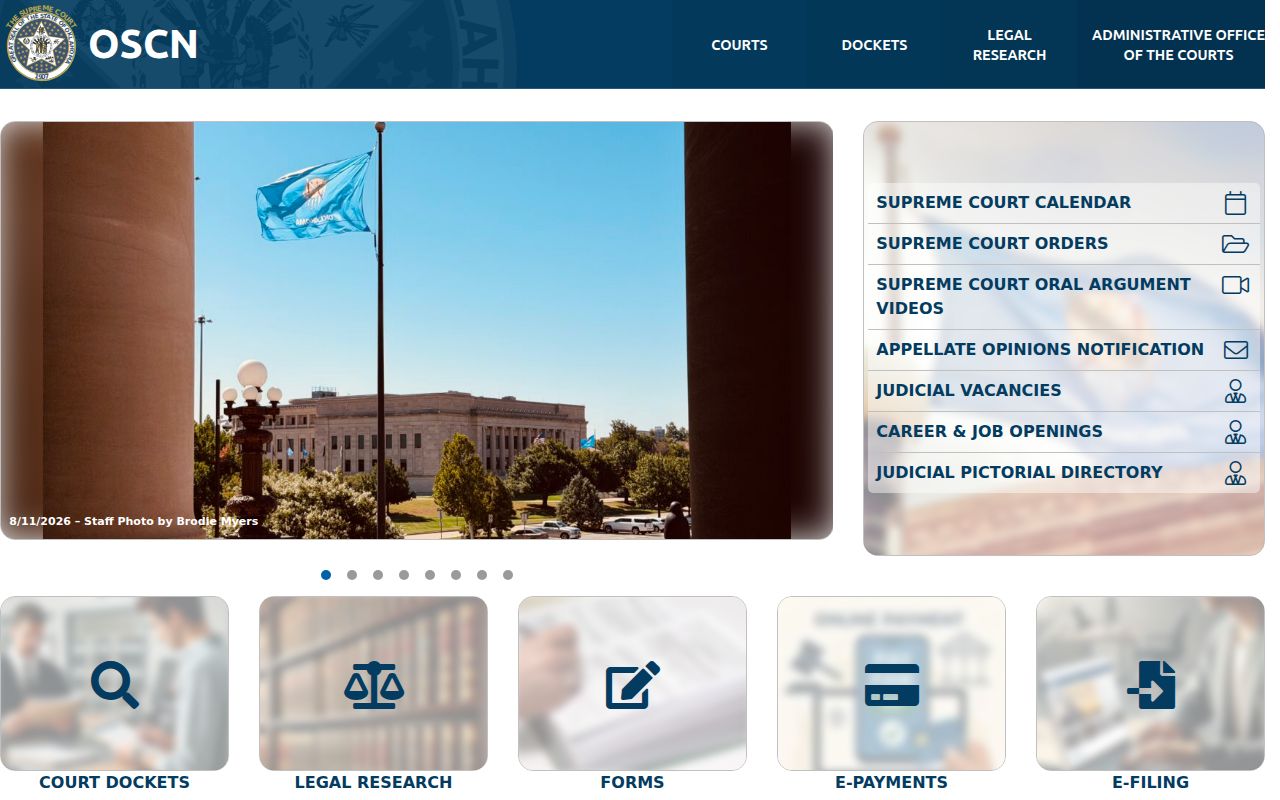
That broad gateway is useful for legal research, while the docket search and county Court Clerk remain the practical pair for finding a specific case file.
Understand the Oklahoma Court System
Oklahoma has two courts of last resort. The Supreme Court of Oklahoma finally reviews civil matters and supervises the judiciary. The Oklahoma Court of Criminal Appeals finally decides state criminal appeals. Between the civil high court and the trial courts, twelve Court of Civil Appeals judges sit in four divisions. The Supreme Court assigns civil appeals to those panels and may later grant certiorari, a discretionary review of the intermediate ruling. Criminal appeals go from District Court to the Court of Criminal Appeals without a criminal intermediate court.
District Court is the general trial court in every county. It hears felonies, misdemeanors, civil disputes, divorce, juvenile matters, probate, guardianships, small claims, and state traffic cases. City municipal courts decide ordinance violations. Most municipal courts are not courts of record, so an appeal is tried anew in District Court. Oklahoma City and Tulsa instead operate Municipal Criminal Courts of Record. The detailed Oklahoma court system overview follows these routes and also explains federal and specialized tribunals.
Civil case flow: District Court › Supreme Court assignment › Court of Civil Appeals › possible Supreme Court certiorari.
Criminal case flow: District Court › Oklahoma Court of Criminal Appeals.
| Court | Jurisdiction | Case Types |
|---|---|---|
| Supreme Court of Oklahoma | Final civil review and judicial administration | Civil, family, probate, agency, and constitutional appeals |
| Oklahoma Court of Criminal Appeals | Final state criminal review | Convictions, sentences, post-conviction cases, and criminal writs |
| Court of Civil Appeals | Assigned intermediate civil review | Civil judgments, divorce, probate, and agency appeals |
| District Court | General trial jurisdiction in every county | Criminal, civil, family, probate, juvenile, small claims, and state traffic |
| Municipal Court | City ordinance jurisdiction | Traffic, parking, nuisance, and municipal misdemeanors |
Browse Oklahoma Court Record Types
Oklahoma District Court files are grouped by case type, and the prefix often reveals the broad subject. Civil actions can include contracts, injuries, property disputes, foreclosures, name changes, and judgments. Small claims use a streamlined docket. Family records cover divorce, parentage, custody, support, and protective orders. Probate records track estates, guardianships, and trusts. Criminal files begin after a prosecutor files charges and then record hearings, pleas, rulings, disposition, and sentence. State traffic cases appear in District Court, while ordinance citations often stay with the city court.
- Criminal records contain filed counts, appearances, motions, pleas, trial events, disposition, and sentencing entries.
- Civil records identify parties, claims, service, motions, judgments, liens, and post-judgment enforcement.
- Family and divorce records may include petitions, decrees, custody rulings, support orders, and restricted exhibits.
- Probate records show petitions, notices, appointments, claims, inventories, accountings, and final orders.
- Traffic records identify the charge, court events, failure-to-appear action, plea, and disposition.
- Juvenile and adoption records are subject to confidentiality rules and are not ordinary open files.
Eviction, landlord-tenant, foreclosure, protective-order, and appellate matters have their own document paths. A docket result should be read in context. The filing county, court type, case prefix, and current status determine which office can supply the underlying material.
Read Oklahoma Court Records
An Oklahoma docket normally identifies the database, case number, caption, filing date, parties, attorneys, judge, event dates, codes, narrative text, and disposition. Criminal matters add counts, alleged offenses, bond and sentencing events. Civil matters may show judgments and financial entries. A dollar amount beside a docket code is not always the current balance. It can be an assessed cost, bond, fee, judgment, or one line in a longer ledger. Request the clerk's current statement when payment status matters.
| Field | What It Shows |
|---|---|
| Case number | County, year, case-type prefix, and sequence used to identify the file |
| Filing date | When the action entered the court, not always when the underlying event occurred |
| Parties | Plaintiffs, defendants, petitioners, respondents, or the state and accused person |
| Charges or cause | Allegations presented to the court, which are not proof of liability or guilt |
| Disposition | The outcome of a count or case, such as dismissal, plea, verdict, or judgment |
| Sentence or judgment | The court's ordered consequence or civil relief, subject to later modification or appeal |
- Docket
- The chronological index of filings and court events.
- Disposition
- The recorded result of a count, claim, or case.
- Certified copy
- A clerk-authenticated reproduction used when formal proof is required.
The OSCN search interface exposes the county, name, case number, date, and case-type controls used to locate these entries.
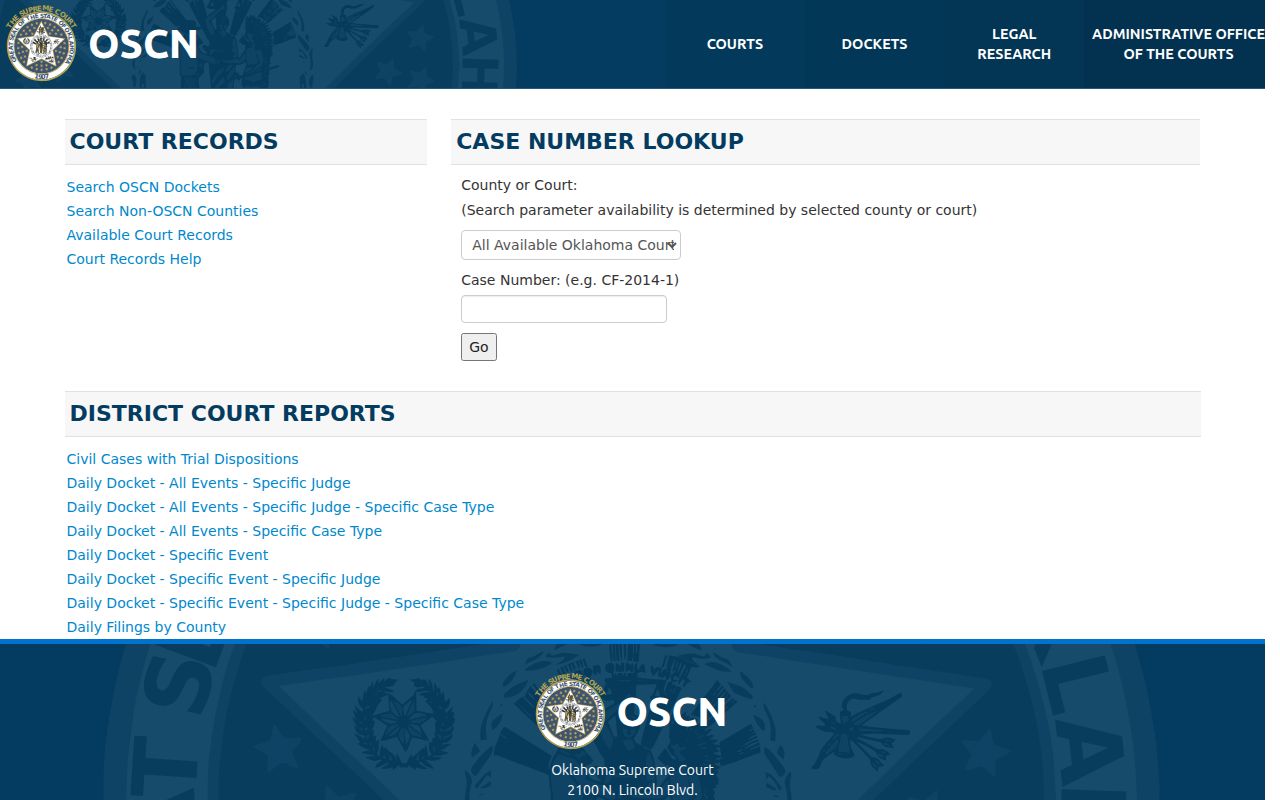
Those controls narrow the index. The filing county's Court Clerk remains the source for pleadings, exhibits, decrees, orders, and certified records.
Use Oklahoma Statewide Record Systems
Several Oklahoma records belong to state agencies rather than a county case file. The Oklahoma Department of Corrections Offender Lookup covers people currently or formerly in state custody or supervision. It is not a county jail roster. OSBI's CHIRP supplies paid Oklahoma criminal-history searches, which compile repository data rather than reproduce a complete court file. Service Oklahoma and the Department of Public Safety handle driver records under purpose and identity restrictions. The public sex-offender registry has its own search and disclaimer.
Marriage and divorce copies do not come from Oklahoma State Department of Health Vital Records. That state office certifies births and deaths. Marriage licenses and divorce decrees remain with county Court Clerks. County jail custody and local warrants likewise require sheriff, court, or city channels. The Oklahoma inmate records, warrant records, traffic, and marriage pages keep these systems separate.
| System | What It Holds | Run By |
|---|---|---|
| ODOC Offender Lookup | State prison and supervision profiles | Oklahoma Department of Corrections |
| OSBI CHIRP | Oklahoma criminal-history repository results | Oklahoma State Bureau of Investigation |
| Service Oklahoma driver records | Motor vehicle reports and full driving products | Service Oklahoma and DPS |
| OSDH Vital Records | Birth and death certificates, not marriage or divorce copies | Oklahoma State Department of Health |
| Sex Offender Registry | Public profiles for covered Oklahoma registrants | Oklahoma Department of Corrections |
Apply Oklahoma Court Access Laws
The Oklahoma Open Records Act states a policy of prompt, reasonable access to public-body records unless another law protects the material. Court access also depends on judicial rules, case-specific orders, and confidentiality laws. Start with the actual custodian. A Court Clerk handles District Court files, police and sheriffs hold their agency reports, OSBI holds statewide criminal histories, and DOC holds prison information. A request should identify an existing record, date range, preferred format, and whether certification is needed.
Key Statutes:
51 O.S. §§24A.1-24A.32 sets the Open Records Act framework, including inspection, copying, exemptions, and permitted charges.
12 O.S. §32.1 requires specified personal identifiers to be excluded or redacted from court filings.
22 O.S. §18 defines criminal-record expungement eligibility categories; a qualifying person still needs the required court process.
Title 10A juvenile provisions limit access and provide court-controlled sealing rules for protected juvenile material.
The Oklahoma Attorney General describes the Public Access Counselor and open-record resources available for education and mediation.
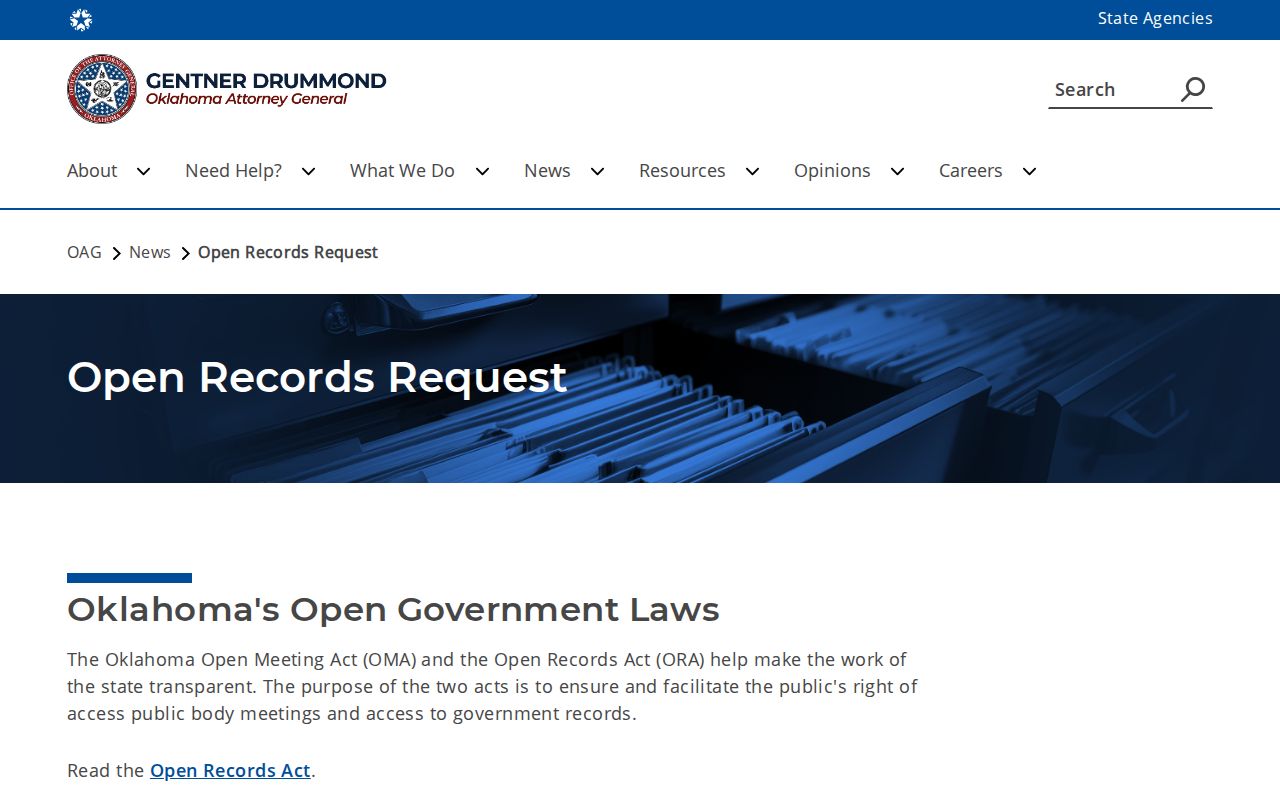
That resource can clarify public-record duties, but it is not the custodian of a county court file and does not replace a judicial order.
Protect Confidential Oklahoma Records
Juvenile delinquency and deprived-child files are not ordinary public case records. Adoption petitions, reports, identifying information, and decrees are confidential. Mental-health commitment files can contain protected evaluations and treatment evidence. Public pleadings should omit specified Social Security numbers, account data, minor identifiers, protected addresses, and other sensitive fields. Redaction removes protected details while leaving the public balance available; sealing restricts access to a larger record under law or court order.
Expungement is not automatic after dismissal or passage of time. Eligibility under 22 O.S. sections 18 and 19 can depend on the outcome, offense type, number of convictions, sentence completion, waiting period, and pending cases. A verified petition is filed in the proper District Court and must identify affected custodians, including the clerk, arresting agency, prosecutor, and OSBI when applicable. After a signed order, each named custodian needs time to process it. Independent news, federal records, and access authorized by law may remain.
Find Oklahoma Court Records by County
Every Oklahoma county has a District Court and an elected Court Clerk, even when judges serve a multi-county judicial district. The filing county controls the database and source file. Oklahoma and Tulsa counties have the state's largest dockets and separate city courts of record. Cleveland, Canadian, Comanche, and Rogers counties are other major regional or metro filing centers. Each remains a distinct county database, so a shared metro area does not merge records.
Oklahoma County
Oklahoma City · Capital metro District Court and a separate city court of record
Tulsa County
Tulsa · Large District Court docket and separate municipal court of record
Cleveland County
Norman · Fast-growing metro District Court records
Canadian County
El Reno · Western Oklahoma City metro filings in a separate database
Comanche County
Lawton · Southwest regional District and municipal court access
Rogers County
Claremore · Tulsa metro county with its own clerk and OSCN database
Browse the full directory of all 77 Oklahoma counties to open the court records site for any county.
Check Oklahoma Court Record Fees
OSCN docket searches are free, but a docket view does not include every document. Oklahoma Court Clerks quote plain-copy, certified-copy, archive, research, postage, and payment charges based on the request. Civil, divorce, probate, and small-claims filing totals also vary because statutory assessments, service, publication, and local handling can apply. Ask for a written estimate and state whether the copy must be certified. An indigent party may submit the applicable pauper affidavit, but a judge decides waiver or deferral and outside costs may remain.
- OSCN docket search: free.
- OSBI name criminal history: $15, plus applicable transaction processing.
- OSBI fingerprint criminal history: $19; fingerprint collection may cost extra.
- Plain or certified court copy: request a current county Court Clerk quote.
- Civil, divorce, or probate filing: county quote required because the case and service needs control.
Open-record agencies may charge copying or media costs and qualifying search time under 51 O.S. section 24A.5. Narrow wording helps control cost. Court receipts can distribute assessments across many funds, so one quoted deposit should not be treated as a universal Oklahoma filing fee.
Interpret Oklahoma Court Record Events
Read docket entries in time order and do not stop at the first charge or warrant line. A filed charge is an accusation. It may be amended, dismissed, merged, or resolved by plea or verdict. A bench warrant entry may later show recall. Administrative reassignment is not a ruling on the merits. Terms such as plaintiff and defendant identify party roles, while petitioner and respondent are common in family and probate matters. A disposition records an outcome, but each count may have a different one.
OSCN also hosts Oklahoma statutes, court rules, and appellate opinions through its legal research portal.
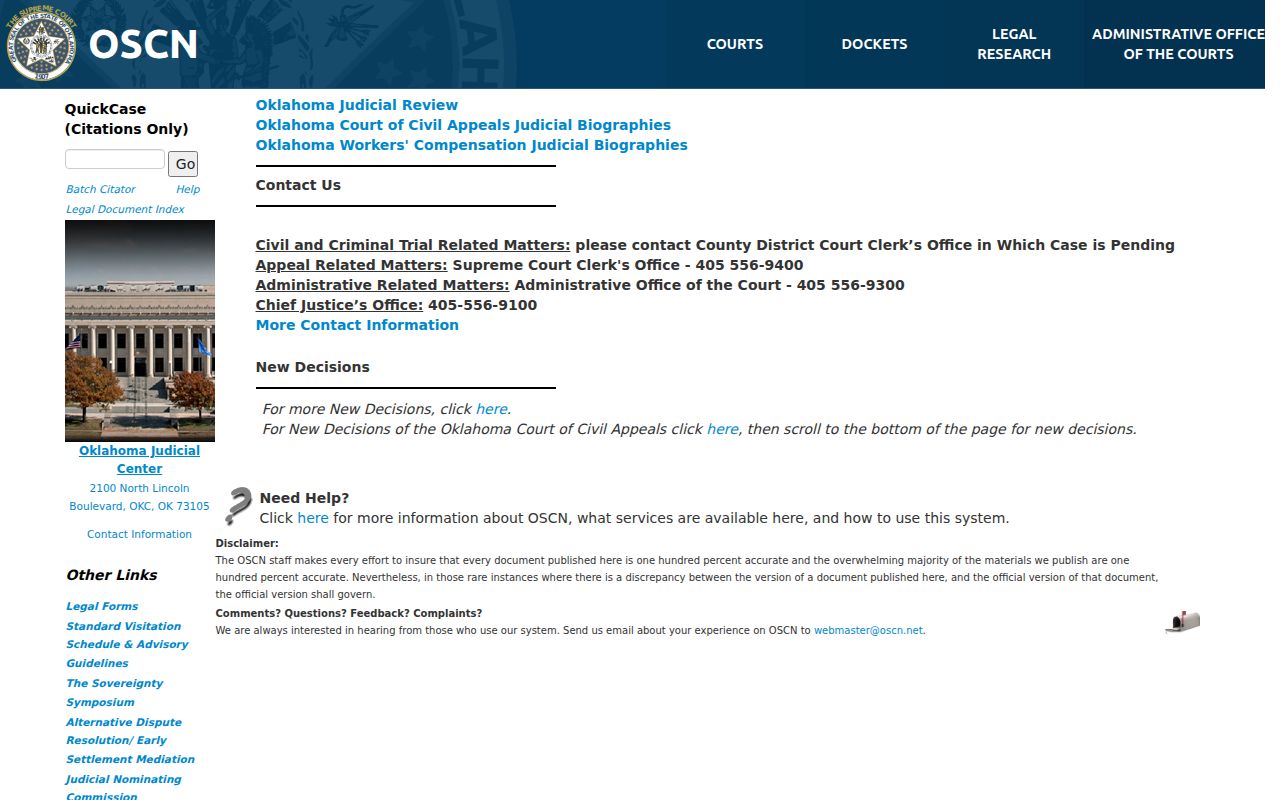
Statutes and opinions help explain a docket term, yet the signed order or judgment controls the result in the individual file.
Verify Oklahoma Record Accuracy
Online coverage varies because Oklahoma counties digitized records at different times. An absent result can reflect spelling, an alias, the wrong county, an older paper file, a municipal case, delayed entry, or lawful restriction. A result can also concern another person with the same name. Match full name, age or birth information when lawfully shown, county, case type, date, and other facts before drawing a conclusion. For an official use, obtain a certified document from the responsible clerk instead of relying on a screen capture.
Corrections belong with the source custodian. The Court Clerk addresses case-file or docket issues, OSBI handles its criminal-history repository, DOC handles offender profiles, and DPS or Service Oklahoma handles driver records. Provide the record identifier and supporting proof. Do not ask one agency to alter a different agency's database.
Note: Confirm the final event and obtain the signed order from the filing county before relying on an Oklahoma docket.
Oklahoma Court Records Questions
Is OSCN a complete case file?
No. OSCN is a strong statewide docket index for District Court and appellate records, but documents, exhibits, certified copies, and older files often remain with the county Court Clerk. Municipal coverage is also incomplete. Use the docket to identify the case, then request the exact item from its custodian.
Where are Oklahoma marriage records?
The Court Clerk in the issuing county keeps marriage-license records. The same county office holds District Court divorce files and decrees. Oklahoma State Department of Health Vital Records handles birth and death certificates, not marriage or divorce copies.
Does an arrest record prove guilt?
No. An arrest records a law-enforcement event, and a filed charge is an accusation. Read the later court events for amendment, dismissal, plea, trial, and disposition. OSBI criminal-history data and a county case file have different coverage, so verify both when the distinction matters.
How are city traffic cases found?
Begin with the issuing municipal court because city ordinance citations may not appear in OSCN. State-law traffic cases filed in District Court can appear in the county database. The driver record from Service Oklahoma is a separate state product and is not a substitute for the court file.
Are Oklahoma court records free?
OSCN docket searching is free. Clerks may charge for copies, certification, archive work, postage, or qualifying research. Filing fees also vary by case and service needs. Ask the county Court Clerk for the current amount before sending payment.
What if no online result appears?
Try name variants, a different year, case prefix, county, or city court. Then contact the county Court Clerk for older or non-imaged District Court material. A sealed or confidential file may not be available without statutory authorization or a court order.